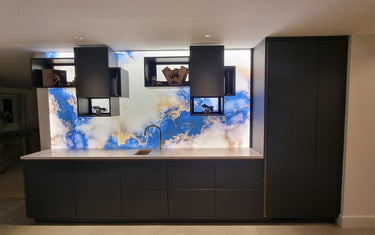
The right glass splashback starts with two choices: the finish and the colour. The finish decides how the wall handles light, reflections and everyday marks. The colour decides how it sits with your cabinets, worktop and handles. This guide compares eight finishes with photos of real CreoGlass kitchens, then walks you through choosing and testing a colour before you order.
Jump to: Compare finishes · Choose the colour · Test samples · Combinations to copy · Hobs, joints and cleaning · DIY or fitted · FAQs
Glass splashback finishes compared
| Finish | The look | Best for | Day-to-day care |
|---|---|---|---|
| Gloss colour | Deep, glossy block of colour | Most kitchens; bright, modern schemes | Wipe clean; shows smears in strong light |
| Matt colour | Soft, low-sheen colour | Calm schemes, matt cabinets, bright windows | Fewer reflections and visible smears |
| Glitter & sparkle | Metallic shimmer that catches light | Plain units that need a focal point | Texture hides marks well |
| Mirror | Silver, bronze or grey reflection | Small or dark kitchens that need light | Needs the most frequent wiping |
| Antique mirror | Softened, distressed reflection | Classic, Shaker and period kitchens | Pattern disguises marks |
| Printed & stone-effect | Marble, stone, abstract or your own image | A statement wall without stone upkeep | Wipe clean, no grout or sealing |
| LED backlit | Glass lit from behind | Feature walls, islands and bars | Plan power and access early |
Gloss colour glass

Gloss is the classic glass splashback: colour applied to the back of toughened glass, so the front stays smooth and reflective. It makes colour look richer and bounces light around the room. It suits almost any kitchen, from a bold accent like lime green to a quiet cream that blends with the units.

Choose it if: you want a clean, easy surface and a strong or precise colour. Browse plain colour glass splashbacks.
Matt colour glass

Matt glass has a softly etched front, so it reflects less light and shows fewer smears than gloss. Colours read slightly lighter and calmer. It pairs well with matt or painted cabinets and with kitchens that get strong direct sunlight, where gloss can glare.
Choose it if: you want colour without shine. Browse matt colour splashbacks.
Glitter and sparkle glass

Glitter glass suspends metallic flecks behind the glass, so the wall shimmers as the light changes through the day. Copper, silver, gold and coloured sparkles work well against plain white or grey units, giving a simple kitchen a focal point without patterns or artwork.
Choose it if: your units are plain and you want the wall to do the talking. Browse glitter splashbacks.
Mirror: silver, bronze or grey

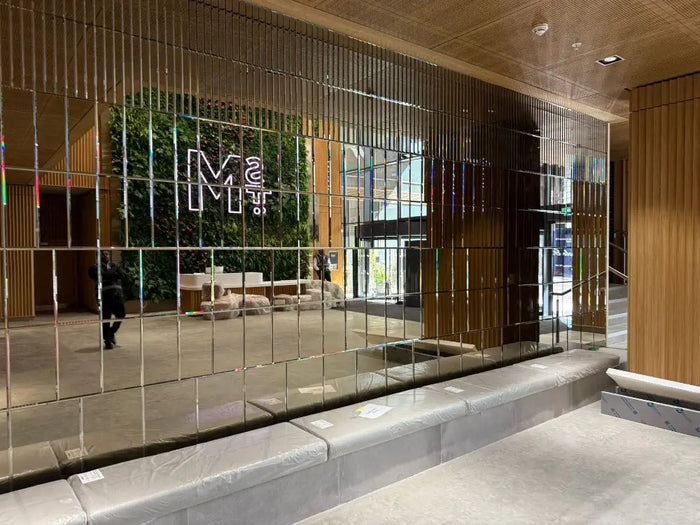
A mirror splashback doubles the light in a room and makes a small or narrow kitchen feel wider. Silver gives the clearest reflection, bronze adds warmth and grey gives a cooler, smoky look. Mirror shows water marks and fingerprints more than any other finish, so it suits people happy to wipe it down often.

Behind a hob: choose a toughened mirror. Non-toughened mirror is not suitable behind a hob. Browse mirror splashbacks.
Antique mirror

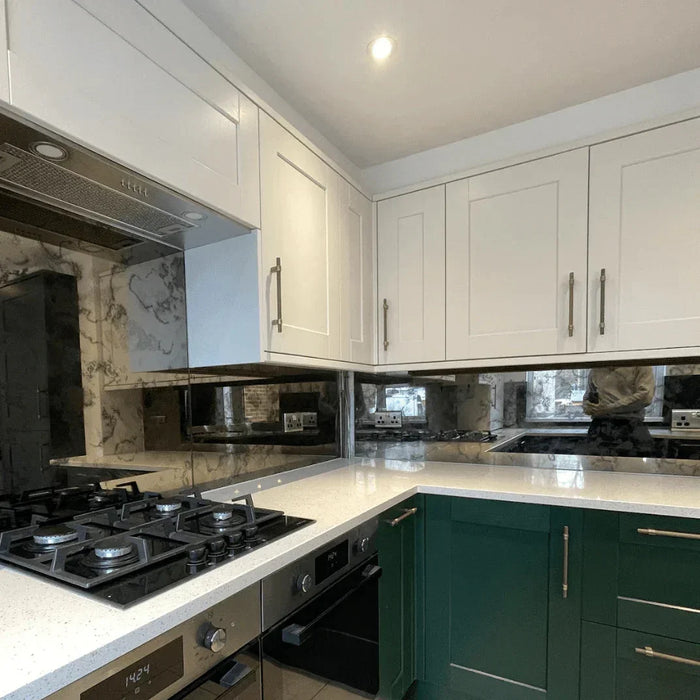
Antique mirror softens the reflection with a distressed, aged pattern. You still get the extra light of a mirror, but the pattern hides marks and feels at home in classic, Shaker and period kitchens. It comes in silver, bronze and grey tones, with several pattern strengths.
Choose it if: you love mirror but want character and less upkeep. Browse antique toughened mirror splashbacks, or read bronze, silver or grey antique mirror?
Printed, stone-effect and liquid ink glass

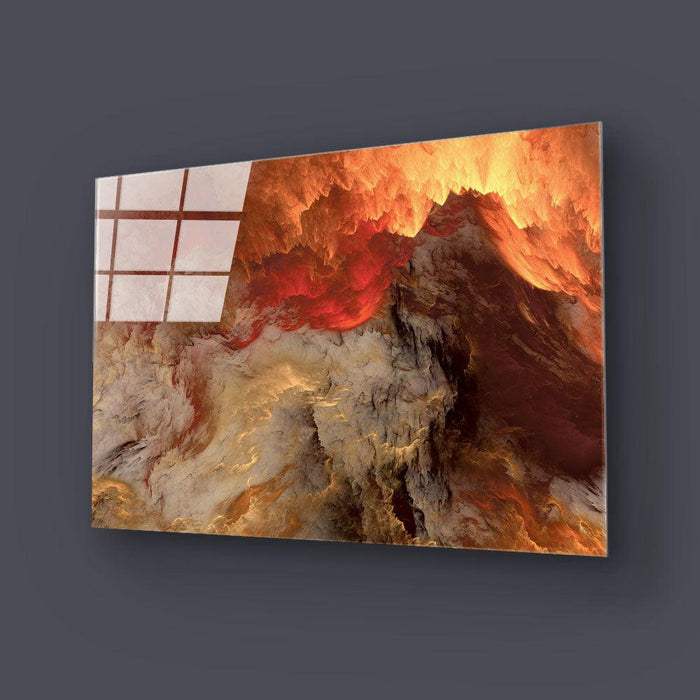
Printed glass puts any design behind the glass: marble and stone effects, abstract art, or your own photograph. Stone-effect glass gives the look of a slab without grout lines, sealing or staining. Liquid ink designs add flowing, one-off colour.

Choose it if: your doors are simple and flat, and you want the wall to be the feature. Use quieter patterns on long runs. Browse printed glass splashbacks or premium decorative glass.
LED backlit glass

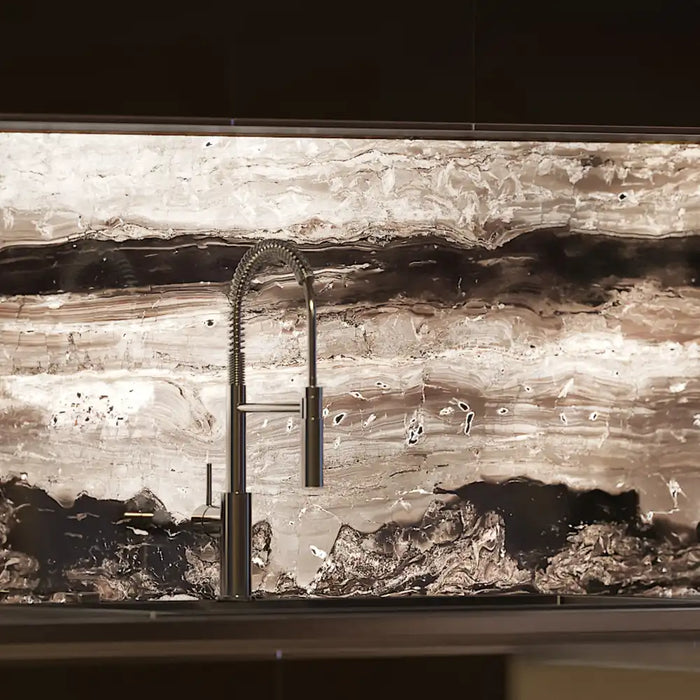
LED backlit glass is lit from behind, so stone-effect and translucent designs glow like a light feature. It turns a splashback, island or bar into the centrepiece of the room, especially in the evening. It needs planning early, because power supply and access for the lighting are decided before the kitchen is finished.
Choose it if: you want a showpiece. Browse LED backlit splashbacks.
How to choose the colour
Start with what will not change, then decide how much attention you want the splashback to draw.
- Anchor to your fixed finishes. Cabinets, worktop and floor rarely change, so the glass should work with all three. Note whether each one is warm (cream, oak, brass), cool (white, grey, chrome) or neutral.
- Decide: blend or contrast. A splashback close to your cabinet colour makes the kitchen feel calm and larger. A contrasting colour turns the wall into a feature.
- Match the undertone. Warm cabinets suit warm glass colours; cool cabinets suit cool ones. Mixing undertones is what usually makes a colour look "off".
- Think about room size and light. Light colours and mirror help small or north-facing kitchens. Dark, rich colours work best in big, bright rooms.
- Coordinate with metals. Chrome and stainless steel suit cool tones and grey or silver mirror. Brass and copper suit warm colours, bronze mirror and copper sparkle.
Need an exact colour? We can match a RAL or Dulux reference. Confirm the code with us in writing before production, as colour on glass can read slightly differently to paint.
Test samples in your own light

Glass changes with the light. A colour that looks right in a showroom can look darker on a north-facing wall or warmer under LED strips. Always see the real material in your kitchen before you commit.
- Order samples of your two or three favourites.
- Hold them against the wall behind the hob and the sink, next to your cabinet door and worktop.
- Look at them in the morning, at midday and in the evening.
- Check them with your under-cabinet and ceiling lights on.
Colour combinations you can copy
- Scandi calm: oak units, pale stone worktop, light greige or ivory gloss glass.
- Modern luxe: navy doors, brass handles, deep green glass or bronze mirror.
- Clean monochrome: white doors, black appliances, grey mirror or a black marble-effect print.
- Soft coastal: pale blue units, chrome taps, misty blue or white matt glass.
- Classic Shaker: grey or sage Shaker doors, quartz worktop, silver or bronze antique mirror.
- Bold and bright: grey units with lime, orange or teal gloss glass as the single accent.
Behind the hob, joints and cleaning
- Behind a hob: toughened glass is suitable behind a hob when it is fitted to the hob manufacturer's clearance requirements. Non-toughened mirror is not suitable behind a hob. For glitter, printed, matt and LED designs, check the product specification for that position, or ask us.
- Safety standard: ask for toughened safety glass to BS EN 12150.
- Joints and cut-outs: larger panels mean fewer joints. Socket and switch cut-outs must be agreed before manufacture, because toughened glass cannot be cut or drilled afterwards.
- Over old tiles: often possible if the tiles are flat and firmly fixed; a survey confirms it.
- Cleaning: a soft cloth and a mild glass cleaner. Avoid scourers and abrasive creams.
DIY or fitted: choose how you buy
DIY and supply only: choose a design and size online, measure the wall yourself and fit it, or ask your kitchen fitter. Start with our splashback measuring guide and the DIY splashback range.
Made to measure and fitted: for full runs, cut-outs, mirror and LED work, we survey, manufacture and install. Send your postcode, a few photos and rough sizes for a quote.
Step-by-step: from idea to order
- Note your cabinet, worktop and floor colours and their undertones.
- Pick a finish from the comparison above.
- Shortlist three colours or designs.
- Order samples and test them in your light for a few days.
- Choose one calm and one bold option, and check them against your handles and lights.
- Confirm the exact colour, or RAL/Dulux code, in writing.
- Measure for DIY, or book a survey for a fitted splashback.
- Approve the final sizes and cut-outs before manufacture.
Frequently asked questions
Will my colour look darker on glass?
Often, slightly, especially in low light or on a north-facing wall. Gloss deepens colour; matt softens it. Test a sample with your own lights on.
Which splashback finish is easiest to keep clean?
Patterned finishes such as glitter, antique mirror and printed stone hide marks best. Matt shows fewer smears than gloss. Plain mirror needs the most wiping.
Is a mirror splashback a good idea for a small kitchen?
Yes. It adds light and makes the room feel bigger. Choose a toughened mirror behind a hob, and expect to clean it more often than coloured glass.
Can a glass splashback go over existing tiles?
Often, if the tiles are flat, sound and firmly fixed. A survey confirms whether it can be fitted over them.
Can you match the colour of my cabinets or paint?
Yes. Send us the RAL or Dulux reference, and approve the final colour in writing before production.
What standard should my splashback glass meet?
Toughened safety glass to BS EN 12150.
Ready to choose?
Order samples to see finishes in your own light, browse all kitchen glass splashbacks, or send us your photos and postcode for a made-to-measure quote. Prefer to talk it through? Call 01923 947454.