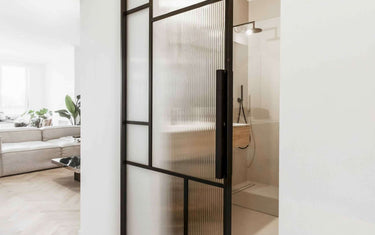
A reeded glass door gives you light and privacy at the same time. The fine vertical ribs blur what is behind the glass, so a study, en suite or snug can borrow daylight from the hallway without being on show. This guide explains how reeded glass compares with fluted, frosted and clear glass, where each one works best, and what to think about for frames, safety and sizing before you choose a door.

What is reeded glass?
Reeded glass is patterned glass with narrow, rounded vertical ribs pressed into one face. Each rib acts like a small lens, so light passes through freely but shapes behind the door become soft vertical streaks. Close up you may see movement and colour; from a few metres away, detail disappears.
It has been used in British homes since the early twentieth century, which is why it suits period properties, yet it looks equally at home in a contemporary extension with slim black frames.
Reeded vs fluted glass
The two names are often used interchangeably, but in the trade there is a useful distinction. Reeded glass has fine, closely spaced ribs. Fluted glass has wider, deeper ribs with a bolder texture. Fluted reads as more decorative and slightly more private at a distance; reeded is subtler and lets the frame and the room do more of the talking.

Reeded, fluted, frosted or clear: which gives the right privacy?
| Glass | Privacy | Light | Look | Best rooms |
|---|---|---|---|---|
| Clear | None | Maximum | Open, minimal | Kitchen to living room, extensions |
| Reeded | Good, shapes blurred | High | Fine vertical texture | Studies, snugs, dining rooms, hallways |
| Fluted | Good to high | High | Bolder ribs, decorative | Statement doors, wardrobes, utility rooms |
| Frosted (satin) | High, even | Soft, diffused | Smooth and quiet | Bathrooms, en suites, bedrooms |
One point people often miss: reeded and fluted glass blur shapes, but they do not hide light and colour completely. At night, with lights on behind the door, a silhouette can still show as a soft shape. For a bathroom or en suite where full privacy matters, frosted glass, or a reeded pattern combined with a satin finish, is the safer choice.
Which side should the ribs face?
On most doors the ribbed face sits on the side that sees less cleaning and handling, usually the inside of a room, with the smooth face towards the busier side. A smooth face is easier to wipe, which matters near kitchens. Some designs place the ribs outwards because the texture catches light better. We confirm the orientation with you before manufacture.

Frames: black steel, bronze or white
Slim black steel
The classic pairing. Black glazing bars give reeded glass a crisp, architectural outline, and the grid can be simple or multi-pane. Our Crittall-style steel doors are made in this style. Crittall is a registered trademark of Crittall Windows Ltd; Crittall-style doors are steel doors in that design style, not made by Crittall.
Bronze and brass tones
Warm metal frames soften the look and suit pale stone, timber and plaster interiors. A floor-to-ceiling reeded panel in a slim bronze frame turns a simple doorway into a feature.

White frames
White steel frames are lighter on the eye and work well in Scandinavian or coastal schemes. With clear glass they almost disappear; with reeded glass they add gentle texture.

Where a reeded glass door works best
- Home offices and studies: you keep daylight from the hallway, while video calls and paperwork stay out of view.
- Kitchen to dining room: cooking smells and noise stay in the kitchen, yet the two rooms still feel connected.
- Snugs and TV rooms: a reeded door closes off a cosy room in the evening without making the hallway dark.
- Hallways with no windows: borrowed light through a reeded door can transform a dark entrance or landing.
- Utility rooms and boot rooms: the texture hides everyday clutter, which clear glass would put on display.
Reeded glass also works in partitions and fixed side panels beside a door. Continuing the same glass across a whole screen keeps the look consistent and lets more light through than a solid wall.
Mixing reeded glass with other finishes
Many of the most successful designs combine glass types. A door might have reeded glass in the lower panes for privacy and clear glass above for views and light. A pair of double doors can use reeded glass while the side panels stay clear. On a grid door, the glazing bars give natural break points, so a change of glass looks deliberate rather than patched.
Hinged or sliding?
A hinged reeded door suits a standard doorway and can latch or lock, which is useful for a study or bathroom. A sliding door needs no swing space and works well across wide openings or where furniture sits close to the doorway. Reeded glass is particularly effective on large sliding screens, where the vertical ribs echo the height of the opening. See our double sliding glass doors for wide openings.

Safety glass and building regulations
Glass in doors is one of the places where building regulations require extra care. Approved Document K treats glazing in doors within 1500mm of floor level, and glazing in side panels within 300mm of a door's edge, as critical locations. Glass there should break safely, be robust or be protected. Our doors use toughened safety glass, which is much stronger than ordinary glass and breaks into small, blunt pieces if it is ever broken.
Standard glazed doors are not fire doors. If your door is on an escape route, for example off the hallway in a three-storey house or a loft conversion, a fire-rated door may be needed. Tell us at the quotation stage so the right specification can be confirmed.
Sizes and measuring
Our doors are made to measure for each opening rather than cut from stock sizes. Measure the structural opening width at the top, middle and bottom, and the height at both sides, then send us the smallest figures with a few photos. For full-height openings in extensions and new builds, taller doors are available. If you are unsure, we can survey the opening.

Cleaning reeded glass
Use a soft cloth or a soft-bristled brush along the ribs with warm water and a little mild detergent, then dry with a microfibre cloth. Avoid abrasive pads, which can dull the surface. Keeping the ribbed face on the less-used side of the door reduces how often it needs cleaning.
Reeded glass doors: frequently asked questions
Can you see through a reeded glass door?
Not clearly. You will see light, colour and blurred movement, but not detail. At night, a lit room behind the door may show a soft silhouette.
Is reeded glass suitable for a bathroom door?
It can be, but frosted glass gives more even privacy. If you love the reeded look, ask about combining it with a satin finish.
Is reeded glass the same as fluted glass?
They are closely related. Reeded usually means finer ribs; fluted means wider, deeper ribs. Both are patterned glass that blurs the view while letting light through.
Does reeded glass suit a period home?
Yes. Reeded glass was widely used in early twentieth-century British homes, so it sits naturally in Edwardian and 1930s properties as well as modern interiors.
Choose your reeded glass door
Browse our internal glass doors and the full glass doors range, then send us your opening sizes and photos for a photo-based guide price, or book a survey and we will help you choose the glass, frame and configuration.