Good hallway mirror ideas solve a hallway's real problems: it is often narrow, short of daylight and the first thing anyone sees. A well-placed mirror can make a tight entrance feel twice the width, bounce light from a single window down a corridor and give you a last look before you leave the house. This guide covers where to put a mirror in a hall or on a landing, which sizes and finishes work, how large mirrors are fixed safely in a busy space, and what to decide before you order.

What a hallway mirror should do
Decide the mirror's job before its shape. In a hall or landing it usually does one or more of these:
- Widen a narrow space. A mirror along one long wall makes a corridor read almost twice as wide.
- Bring in light. Halls rarely have much glazing. A mirror opposite or beside a fanlight, side window or glazed door spreads what daylight there is.
- Give you a full-length check. Coats, shoes and keys live here, so a full-height mirror is genuinely useful.
- Make an entrance. In a larger hall, a mirror is part of the first impression of the house.
Stand at the front door and look down the hall. Whatever sits opposite the wall you have in mind is what the mirror will show every day, so check it is something worth doubling.
8 hallway mirror ideas that work
1. Full-height panels on the long side wall
In a narrow entrance, the most effective move is often the simplest: full-height mirror on the long side wall, floor or skirting to ceiling. It removes the "corridor" feeling, lets you see your whole outfit and costs nothing in floor space, which matters where every centimetre counts.

2. A mirror above a console table
A slim console with a mirror above it gives the hall a natural landing point for keys and post, and the mirror doubles any lamp or object on the table. For a more architectural look, take the mirror from the console top to the ceiling rather than hanging a framed piece.

3. Line the landing
Landings are often the darkest part of a house. A run of mirror panels on the landing wall picks up light from the stairwell and makes the upstairs feel open. Panels can be planned around doors, light switches and frames so the mirror looks built in.
4. Bevelled panels for depth and sparkle
A bevelled edge on each panel catches light along every joint, which adds a subtle sparkle under ceiling lights or a chandelier. It suits period and classic interiors, and it gives a large area of mirror more texture than plain flat panels.
5. Bronze or grey tint for warmth
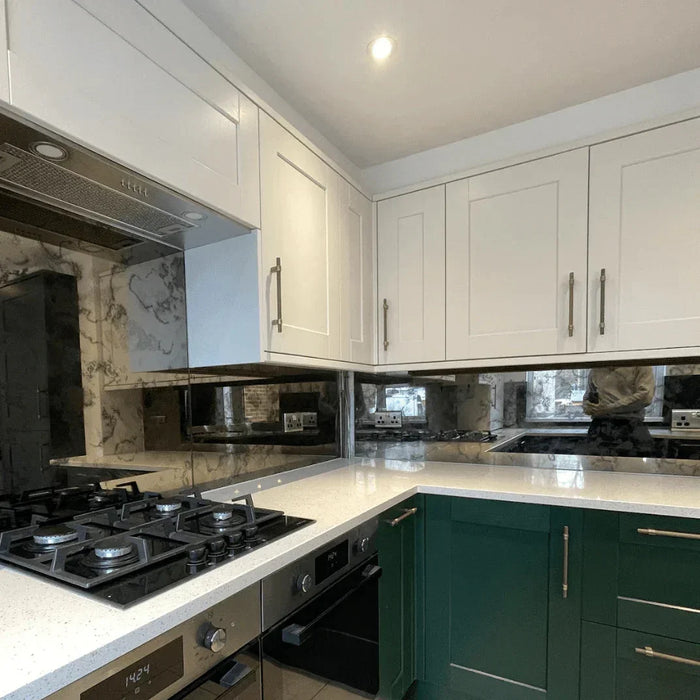
Clear silver mirror gives the brightest reflection. In a hall with dark floors, panelling or a lot of evening use, a bronze or grey tint can feel warmer and more considered. Tinted mirror also makes reflected clutter less obvious.

6. Bevelled tiles with a framed edge
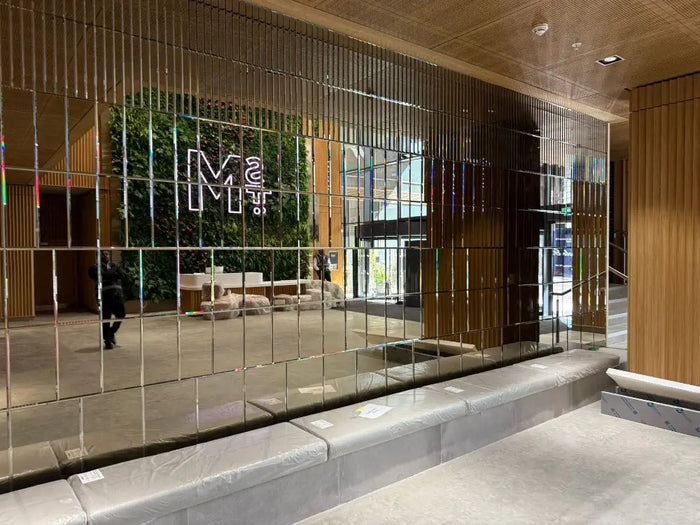
Mirror tiles set in a regular or staggered pattern turn a hallway wall into a feature in its own right. A slim black or brass frame around the perimeter gives the edge a finished, architectural line. Tiles suit walls where you want pattern more than a perfectly continuous reflection.

7. Mirror at the end of a long corridor
A mirror on the end wall of a long hall seems to extend it and gives the eye somewhere to land. Keep it in proportion with the corridor's width, and light it well, because an end wall is often the darkest point.
8. Antique mirror for character
Antique mirror has a softly aged, speckled finish that suits period houses and darker, layered schemes. It still adds light but reflects less sharply, which can be calmer in a busy entrance. Our guide to antique mirror walls covers bronze, silver and grey finishes, and you can browse antique toughened mirrors.
Where not to put a hallway mirror
- Directly facing the front door if the door is fully glazed or faces the sun, as it can throw glare back into the hall.
- Where coats, prams or bikes will rub against it. Leave clearance or plan storage on another wall.
- Behind a door's swing, where a handle could strike the glass. Fit a door stop or move the mirror.
- Opposite clutter such as shoe racks or a meter cupboard, which the mirror will show twice.

Choosing the size and format
For a framed mirror above a console, about two thirds of the console's width is a reliable rule. For a full-height mirror, run it from skirting to ceiling, or line it up with a dado rail or door head so it looks intentional.
Large panels with tight joints give the cleanest reflection and look calm. Several panels are also easier to carry up stairs and round tight corners, which is often the deciding factor in a hall or landing. Tiles and bevelled panels add pattern where a perfect reflection matters less.
Fixing a large hallway mirror safely
A hall is a busy route with doors, bags and children passing all day, so how the mirror is made and fixed matters as much as how it looks.
- Safety backing or toughened mirror. A safety film on the back is designed to hold pieces together if a mirror breaks, and toughened mirror is stronger and breaks into small fragments. Approved Document K sets out "critical locations" in doors, side panels and low-level glazing where glass must break safely or resist impact. A mirror bonded to a solid wall is not usually treated the same way, but safety backing or toughened mirror is sensible at low level and beside doors.
- The right adhesive and support. Large mirrors need a mirror-safe adhesive that will not damage the silvering, plus mechanical support such as a bottom channel or clips.
- A flat, dry, sound wall. Uneven plaster or dot-and-dab plasterboard can distort the reflection. Pilkington's guidance is that uneven walls should be levelled with suitable soft spacers and that new plaster must be clean and fully dry before mirrors are fixed (Pilkington installation tips).
- Cut-outs planned in advance. Light switches, sockets, thermostats and door frames have to be measured and cut before the glass is made.
That is why large hallway mirrors are surveyed before manufacture. Our mirror wall installation service covers measuring, design and fitting inside the M25 plus 20 miles, and you can see more formats in our feature mirror walls collection.
Frequently asked questions
Where should a mirror go in a narrow hallway?
On one long side wall, ideally full height. It makes the corridor read wider without taking floor space. Avoid the wall directly opposite a sunny glazed front door.
Is it a good idea to put a mirror at the end of a hallway?
Yes, if it is lit well. A mirror on the end wall appears to lengthen the hall and gives the eye a focal point. Keep its width in proportion with the corridor.
What size mirror should go above a hallway console?
About two thirds of the console's width is a good rule. For a bolder look, run mirror panels from the console top to the ceiling.
Are large mirrors safe in a family hallway?
Yes, when they are specified and fixed properly. Choose safety-backed or toughened mirror, use a mirror-safe adhesive with mechanical support, and take care with low-level panels and those near doors.
Which mirror finish is best for a dark hallway?
Clear silver gives the most light. If the hall has dark floors or panelling, a bronze or grey tint can feel warmer while still brightening the space.
Plan your hallway mirror with us
Send us a photo of the hall or landing, rough measurements and the look you are after. We will suggest the format and finish that suit the space, give you a photo-based guide price and arrange a survey before anything is made. Contact CreoGlass to start planning.