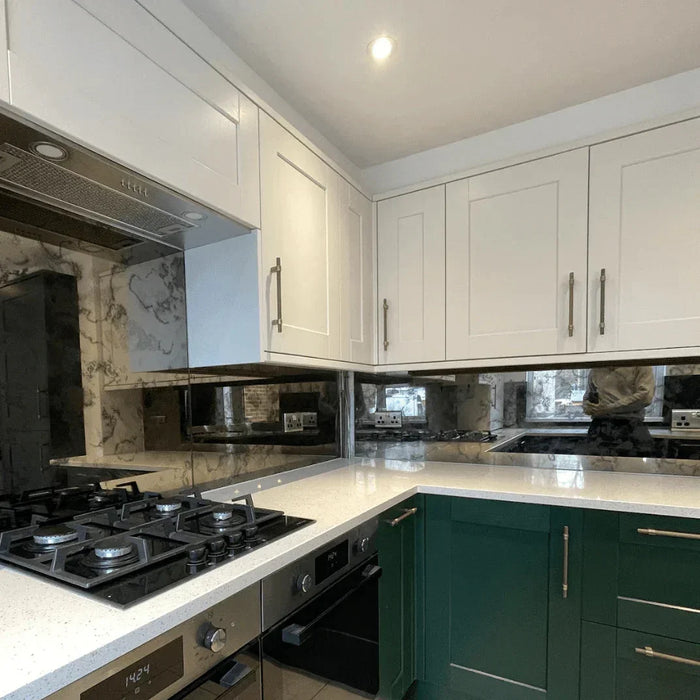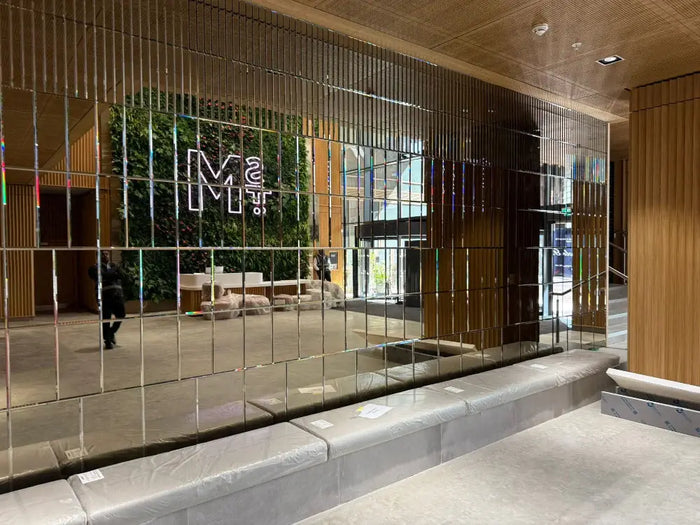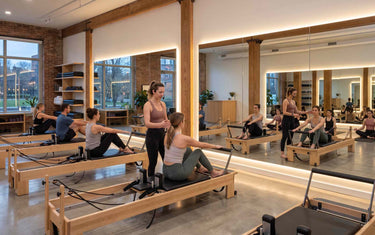

Pilates mirrors influence how large the studio feels. Clients see their movement better. Instructors supervise classes more easily. The space looks premium in photos and social media.
A great Pilates studio needs more than a row of mirrors.
For a traditional Pilates studio, a simple professionally installed mirror wall may be all that is required.
For a premium reformer Pilates studio, however, the mirror wall can become part of the interior architecture — particularly when LED halo lighting is introduced.
At CreoGlass®, we design and manufacture bespoke mirror walls. These are for Pilates studios, gyms, and training facilities. We also serve other commercial fitness environments.
Here are some of the questions we are asked most frequently.
Do Pilates Studios Need Mirrors?

Not every Pilates exercise requires a mirror, but in a commercial studio they can provide several practical and aesthetic advantages.
Mirrors help instructors and clients observe posture, alignment, and movement. Large mirrors reflect light. They also increase a room's visual size. This is useful when reformers take up floor space.
There is another important consideration for commercial studios:
presentation.
Boutique Pilates has increasingly become an interior-design-led business.
Clients are not simply purchasing an exercise class. They are buying an experience.
A professionally designed mirror wall boosts the studio's perceived quality. It's like flooring, lighting, reception furniture, and branding.
LED Halo Mirrors or Standard Mirrors?

This is probably one of the biggest decisions when designing a premium Pilates studio.
The key is to understand that LED halo lighting is an architectural feature. It is not a requirement for the mirror to function.
Standard mirrors can perform perfectly well without LED lighting.
Choose LED halo mirrors when:
- you are creating a premium or boutique Pilates studio;
- the mirrors form a major visual feature within the interior;
- the studio has limited architectural lighting;
- you want softer ambient lighting during classes;
- the studio will be photographed or filmed regularly;
- Instagram, TikTok and other social media content form part of your marketing;
- you want the studio to have a recognisable visual identity;
- the additional investment can help support premium membership or class pricing.
LED halo lighting works particularly well where the mirror appears to float slightly away from the wall.
Illumination behind the mirror creates a halo around its edge. This adds depth to an otherwise flat mirrored surface.
When Is LED Lighting Unnecessary?

There are many projects where we actively recommend not spending the additional money on LED lighting.
For example, LED halo lighting may offer little commercial benefit in:
- functional training facilities;
- school or community fitness rooms;
- studios with excellent existing architectural lighting;
- installations where mirrors are primarily required for movement correction;
- budget-conscious studio fit-outs;
- very large mirror walls where the additional lighting cost becomes disproportionate.
If you need a large, accurate reflective surface, a standard mirror wall is economical. A professional installation is key.
The money saved may be better invested elsewhere in the studio.
What Is the Commercial Advantage of LED Halo Mirrors?
This is where the decision becomes more interesting.
The question isn't simply:
“Do the mirrors need lights?”
The better question is:
“Will the lighting increase the perceived value of the studio?”
For a boutique reformer Pilates business, the answer can sometimes be yes.
LED halo mirrors can contribute to:
Premium positioning
A carefully illuminated mirror wall immediately makes the studio feel more considered and luxurious.
Brand recognition
Distinctive lighting can become part of the visual identity of the studio.
Social media content
Clients frequently photograph attractive fitness environments.
A distinctive studio can therefore generate organic exposure through client-generated Instagram and TikTok content.
Photography and video
Mirror walls with good lighting make strong backgrounds. They are great for instructor videos, photos, and online classes.
Client experience
Lighting has a significant influence on atmosphere.
For slower or more controlled Pilates sessions, softer indirect lighting can create a very different environment from conventional ceiling lighting.
The commercial return therefore isn't necessarily generated by the LED itself.
It comes from the experience and perceived value that the overall interior creates.
How Are LED Halo Mirror Walls Constructed?
A genuine LED halo mirror wall is more involved than simply sticking an LED strip behind a conventional mirror.
Space is required behind the mirror for the lighting system.
Depending on the design, this can involve:
- a supporting subframe;
- stand-off construction;
- LED strips or lighting modules;
- aluminium LED profiles;
- diffusers;
- power supplies and drivers;
- cable routes;
- electrical connection points;
- removable or accessible components for future maintenance.
The distance between the mirror and wall also influences how the light spreads.
Too little space can create visible hotspots.
Too much space can make the mirror appear unnecessarily bulky.
Lighting, mirror dimensions, and wall construction should be considered together. Do not treat the LED as an afterthought.
What Are J-Channels?
J-channels are aluminium profiles used to mechanically support mirror panels.
Typically a lower channel supports the weight of the mirror while a corresponding upper channel retains the top.
This installation method is good for large mirror walls. It provides a mechanical fixing system. It does not rely solely on adhesive.
Commercial J-channel systems are commonly used with thicker safety-backed mirrors, including 6mm mirror panels.
When Should J-Channels Be Used?
J-channels can be particularly useful where:
- multiple large mirrors form one continuous wall;
- additional mechanical support is desirable;
- future mirror replacement needs to be considered;
- the wall construction is suitable for mechanical fixing;
- the visual appearance of the channel works with the studio design.
They can also provide a neat horizontal datum, helping create a consistent line across a long installation.
However, J-channels aren't automatically the right solution for every Pilates studio.
A frameless adhesive installation may create a cleaner appearance where the design calls for completely uninterrupted glass.
The final fixing system should be chosen carefully. Consider mirror size, substrate, and wall construction. Also, safety and desired appearance are factors.
Do You Still Need Mirror Adhesive or Silicone With J-Channels?

A common misconception is that once a mirror sits inside a J-channel nothing else is required.
The answer depends on the installation system and wall condition.
The channel offers mechanical support. A mirror-compatible fixing or adhesive can stabilize the glass. It controls movement. It also compensates for minor wall irregularities.
However, ordinary silicone should not simply be applied behind mirrors without checking compatibility.
Some sealants and adhesives can damage mirror backing.
Where adhesive is required, a product specifically suitable for mirrors should be used.
One J-channel supplier suggests small amounts of adhesive. This aids alignment on slightly uneven walls. It avoids permanently bonding the entire mirror.
For commercial installations, CreoGlass determines the fixing method after assessing the wall construction and mirror specification.
Can I Install Pilates Mirrors Myself?
Technically, yes.
For small, simple installations, an experienced DIY person can install mirrors. A contractor can also use a J-channel system.
However, there's a big difference. Installing a domestic mirror is not like handling large commercial panels. These are 6mm mirrors.
Large mirrors are:
- heavy;
- awkward to manoeuvre;
- easily damaged at their edges;
- potentially dangerous if incorrectly handled;
- unforgiving when walls, floors or ceilings are not perfectly level.
Commercial studios also frequently contain sockets, columns, skirting boards, access restrictions and walls that aren't completely straight.
Small dimensional errors can become very obvious when several mirror panels are installed next to each other.
For these reasons, we generally recommend professional surveying and installation for large commercial Pilates studios.
Why Is a Site Survey Important?
A site survey isn't simply about measuring the width and height of the wall.
We normally also consider:
- wall construction;
- floor and ceiling levels;
- sockets and switches;
- skirting boards;
- columns and structural features;
- access for large mirror panels;
- panel divisions;
- electrical requirements for LED systems;
- finished floor levels;
- potential interference with reformer equipment;
- lighting locations.
The objective is to manufacture the mirrors correctly before they arrive on site.
Bespoke glass cannot simply be trimmed like timber if something has been measured incorrectly.
How Quickly Can Pilates Mirrors Be Installed?
The actual installation is often surprisingly quick.
A simple single mirror wall can be done in one day. This is once mirrors are made and the site is ready.
Larger studios or several mirrored walls may require additional installation days.
The complete project programme is longer because it includes:
- initial enquiry;
- preliminary quotation;
- site survey;
- final measurements and design;
- manufacture;
- delivery;
- installation.
CreoGlass advises that bespoke mirror orders take 10 working days. Larger or complex commercial projects need 10-20 working days.
LED halo installations can require additional coordination because electrical preparation and supporting structures may also be required.
If you're working towards a studio opening date, tell us that date at the beginning of the enquiry.
How Much Do Bespoke Pilates Mirrors Cost?
There isn't a meaningful single price per mirror because commercial installations vary considerably.
For budgeting, commercial mirror walls in the UK cost £250-£500 per square metre. This includes professional supply and installation. Complex or premium installations may exceed this range.
The total investment depends on:
- total mirror area;
- number and size of panels;
- mirror specification;
- safety backing;
- polished edges;
- cut-outs;
- J-channels or other fixing systems;
- access;
- location;
- wall preparation;
- installation complexity.
A bespoke commercial Pilates studio mirror installation can be costly. It can easily be several thousand pounds, not hundreds.
What about LED halo mirrors?
LED halo mirror walls should be treated as a bespoke architectural feature rather than priced simply by square metre.
Additional costs can include:
- subframe construction;
- LED equipment;
- aluminium profiles;
- drivers and transformers;
- electrical preparation;
- additional fabrication;
- installation labour;
- controls or dimming;
- maintenance access.
For this reason, we prefer to price LED Pilates mirror walls. We use actual dimensions and photos of the proposed studio.
What Information Do You Need for a Pilates Mirror Quote?
You don't need architectural drawings to start.
Send us:
- approximate wall width and height;
- your project postcode;
- photographs of the wall;
- the number of mirror walls required;
- whether the studio is new or already operating;
- whether you are considering LED halo lighting;
- your target completion or opening date.
If you have drawings, interior renders or electrical plans, send those as well.
Then we can see if a simple mirror installation is right. Or, if a site survey and detailed design are needed.
Should Every Wall in a Pilates Studio Be Mirrored?
Usually not.
More mirror isn't automatically better.
We normally recommend identifying where reflection provides the greatest benefit to clients and instructors.
For reformer Pilates, the relationship between the reformer beds, instructor position and mirrored wall is particularly important.
Strategically positioning one large mirror wall can often produce a stronger result than installing small mirrors around every available surface.
It can also leave other walls available for branding, acoustic treatment, storage or architectural features.
Designing a Pilates Studio? Think About the Mirrors Early
One easy way to increase installation cost is to wait. Leave it until the very end of the fit-out.
Ideally the mirror design should be considered alongside:
- electrical positions;
- wall construction;
- lighting;
- skirting;
- flooring;
- reformer layout;
- reception and branding;
- air conditioning;
- speakers and controls.
This becomes even more important when LED halo lighting is being considered.
Planning these elements together produces a cleaner installation and can prevent expensive alterations later.
Pilates Mirrors Designed Around Your Studio
CreoGlass® supplies and professionally installs bespoke mirror walls for Pilates and reformer studios across London and the UK.
Our service can include:
Design advice → Site survey → Bespoke manufacture → Delivery → Professional installation
From simple frameless mirror walls to premium LED halo installations, the objective is the same:
The goal is to create a studio that works technically. It should look exceptional. It must support the client experience you want for your brand.
Planning a Pilates or Reformer Studio?
Send us your approximate wall dimensions, project postcode and a few photographs.
We can advise on your needs. Do you need a mirror wall, J-channel, or LED halo system? We will prepare an initial quotation.